
Balaam and the Concept of 'Tempting God'
Balaam is a character from the Bible that most people are familiar with, even if not by name. He's the guy from the Old Testament who was spoken to by a donkey.
Most of us who are familiar with the story know the very basics, that Balaam was riding a donkey down the road. The animal then saw an angel holding a sword standing in the way and rightfully got spooked. Balaam tried to force the animal to proceed anyway, which caused the donkey to miraculously cry out, using human language, and Balaam to eventually perceive the angel also.
Recently and for the first time ever, I decided to read the entire story of Balaam. I wanted to know why was there an angel on the road ready to kill him to begin with. What did he do that was so wrong? And what I found is deeply interesting, perhaps more so than your average Old Testament tale, in understanding how the Most High relates to people.
BALAAM, THE PROPHET
Balaam was actually a prophet. And the first interesting thing to note is that he was not an Israelite but rather one from the Syria/Turkey/Iraq area. That's a compelling fact, because many of us are under the impression that all of the legitimate prophets of the Old Testament (outside of Genesis) were Hebrews. But obviously, that was not the case.
How Balaam became indirectly involved in the Israelite story was through another figure, Balak, who was king of an area known as Moab (which is now in Jordan). The Hebrews decided to set up camp in Moab, after they had already caught wreck in other parts of the region. Furthermore, they were colonial- and expansion-minded. So the people of Moab anticipated a confrontation, one in which the Israelites would prevail.
That's what caused King Balak to reach out to Balaam. He knew that Balaam was a prophet in touch with God and therefore wanted him to come to Moab and "curse" the Israelites. In other words, Balak was planning to attack the Hebrews. But since he knew they were formidable, he wanted divine favor on his side.
So Balak sent an entourage to Balaam to enlist his prophetic help. But the response he got back from the prophet wasn't what he anticipated.
In a dream, Balaam was instructed by the Lord not to go to Moab and furthermore not to curse the Israelites. As we now know or understand, God had already blessed them. It doesn't appear that He told Balaam all of that at first. He rather commanded the prophet to simply tell the king that "the Lord refuses to give me leave to go with you".
WHERE THE STORY GETS INTERESTING
That first part of the story is pretty much run-of-the-mill Old Testament fare. The Hebrews had the favor of God, such that other tribes could not turn the Most High against them, at least not directly, as Balak was trying to do. So you wouldn't expect Him to favor the Moabites over the Israelites.
Balak followed up by sending a second entourage, this time composed of 'more honorable princes' than the first. We know that God already told Balaam not to go. But this time around, besides begging the prophet to come with them, the king's entourage also promised Balaam that if he opted to come to Moab as the king instructed, he'd basically be elevated to prince status himself. Balak king was ready, willing to able to instantly elevate Balaam to A-list status, sorta like what happened to Joseph in Egypt. That's every prophet's dream, in a manner of speaking.
Now this is where the story really starts to get interesting or unorthodox from a biblical standpoint. Since the Lord already told Balaam what His will was, logic would dictate that he would once again refuse and send the king's entourage away emptyhanded. Instead, Balaam entreats them to once again spend the night at his house. In other words, he had received a bigger offer from Balak, one he obviously wanted. So the implication is that Balaam was hoping that after asking God about the matter in a nocturnal dream for a second time, He would recant and be like 'okay, you can go'. And interestingly, that's exactly what happened.
But it wasn't that God actually wanted Balaam to go and curse the Israelites. Instead, He was setting the prophet up. The Most High had placed an angel on the road to kill Balaam as he passed by, on his way to Moab. So the clear implication here is that He was very much upset with the prophet for asking His blessing to do something He already said no to.
THE DONKEY SAVES THE DAY
So that's why Balaam donkey started acting all wild, refusing to continue where he was being led. Whichever way Balaam turned him, the angel would appear, only visible to the animal, menacing with sword in hand.
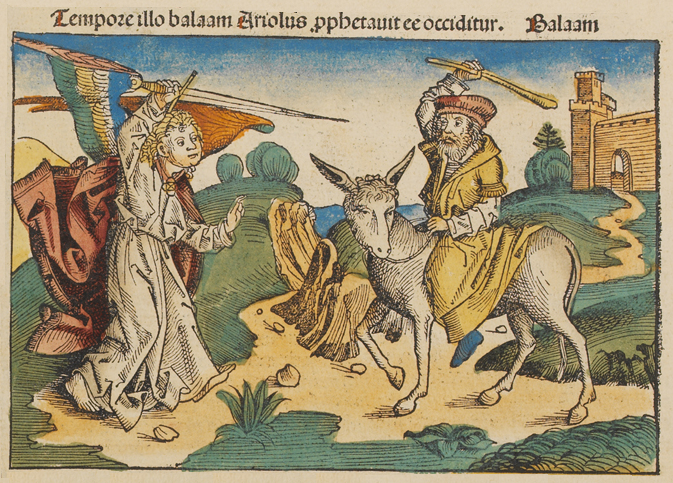 |
| A late-15th century depiction of Balaam upon his donkey. |
Balaam was traveling in a group, a royal entourage even, and this was his own trained donkey. So when it started scraping him up against a wall and all types of stuff, Balaam was thoroughly pissed off. And that anger, on top of the animal refusing to go where he was led, contributed to Balaam fiercely beating it.
So eventually, the Lord empowered the animal to speak in human language. It asked the prophet, most simply put, 'why are you beating me up like this'?!
Eventually, the matter was settled upon Balaam being able to perceive the angel also. He prostates himself, and the angel basically informs him that the donkey who's ass he's kicking just saved his life, as the prophet had become "perverse" in the eyes of the Most High.
Ultimately, Balaam is still given divine instruction to proceed ahead to Moab but is not allowed to say what he or the king wants once he gets there. Instead, he is to receive word from the Most High and then relay it to Balak and co. So during an elaborate ceremony, instead of cursing the Israelites, Balaam is forced to bless them, in front of the princes of Moab, instead. Relatedly, Numbers 23:8 is where the well-known adage 'who God has blessed no man can curse' was apparently derived from.
'TEMPTING GOD'
There's a number of things that can be learned from that story. For instance, many believers are under the simplistic impression that 'if God doesn't want me to do something, then He won't let me do it'.
In a manner of speaking, the Lord was not going to let Balaam go to Moab, at least not in terms of being able to say and do what he wanted. But I don't think most of us want to go as far as being potentially slain by an angel or swallowed by a whale to realize, 'wait a minute, that really wasn't what God wanted me to do'.
Him letting us know once what we should and shouldn't do is enough. And I'm not trying to be preachy or come off as if I'm perfect. But my point is that our personal will doesn't change that of the Most High.
Relatedly, God actually gives Balaam the go ahead to do something that was going to lead to his death. That was because Balaam had the audacity to tempt him.
Jesus refers to the concept of "tempt(ing) the Lord your God" in Matthew 4:7. He does so in a way that it isn't explicitly clear as to what he means. But through the story of Balaam, we get a more lucid understanding of what that concept alludes to.
Jesus made that statement at the time that Satan offered him the world. An alternate translation of his response is "do not put the Lord... to the test". In other words, don't try to make God prove what He says, as if you don't believe Him. Or let's say more specifically in the case of Balaam, don't ask God to bless with something that you already know is against His will. That's some deep stuff right there, because most of us probably do that. Or we pray for something that we feel is against His will, which isn't as bad as actually knowing it is, but still.
And again, the funny thing about it is the Lord being like 'go ahead, Balaam, do you thing'. Or at least that's the impression that the prophet was under. In other words, it was as if God likewise tempted or tested Balaam.
Maybe once He said, 'go ahead, do it', the proper response from Balaam should have been to repent. But instead, he wanted to live large so badly that he actually convinced himself that the Most High completely changed His mind, like 'I don't want you to curse the Hebrews, but you being able to chill in Moab is more important, so f*ck it, go ahead'.
Jesus was offered the world, while Balaam was offered 'promotion, very great honor and whatever he wanted' from the king of Moab. We all have our prices in the mind of Satan but are never expected, in the eyes of God, to sellout.
CONCLUSION
In a manner of speaking, the stakes may not be as high for those of us who are not prophets of God. But there's still a lot to be learned from the story of Balaam, because we all desire things that we think the Lord doesn't want us to have. Furthermore, we may even go as far as to pray for those things. But as illustrated, all because you may achieve it, that doesn't mean that God changed His mind, if he never wanted you to have or do it to begin with. What it could mean, as illustrated by Balaam, is that you may be proceeding more expeditiously towards your own demise.

Comments
Post a Comment